

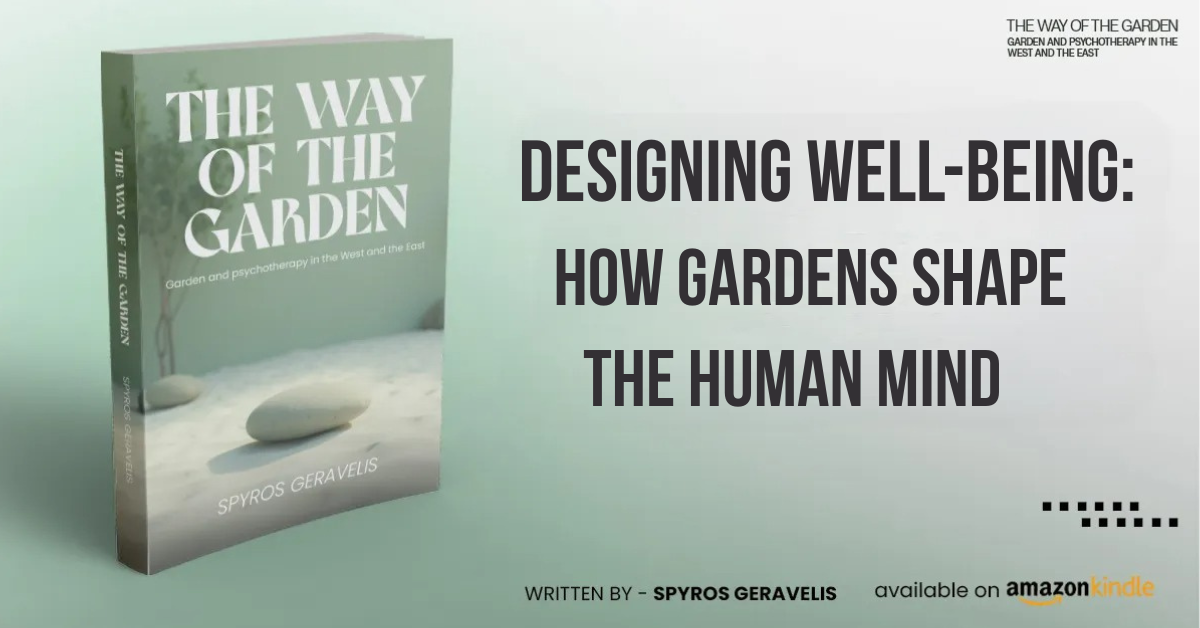
Modern life has gradually shifted humans away from the natural environments that once shaped our rhythms, perceptions, and emotional health. Surrounded by artificial light, digital noise, and accelerated schedules, many people experience chronic stress without recognizing its environmental roots. In The Way of the Garden, Spyros Geravelis explores how consciously designed natural spaces can counterbalance this disconnection and restore psychological equilibrium.
Rather than presenting gardens as aesthetic luxuries, Geravelis positions them as functional environments that directly influence the human nervous system. Drawing on decades of experience in landscape architecture, the book explains how spatial design affects cognition, emotion, and behavior. This approach places gardens within the realm of applied well-being rather than abstract philosophy.
One of the book’s most compelling contributions is its integration of neuroscience with environmental design. Geravelis references research showing that exposure to natural elements reduces cortisol levels, lowers blood pressure, and improves focus. These responses are not incidental; they are rooted in the brain’s evolutionary relationship with nature. Natural textures, organic forms, and non-linear pathways signal safety to the brain, allowing the body to shift out of survival mode and into a state of restoration.
The book also highlights the importance of sensory engagement. Gardens engage more than vision; they invite sound, movement, texture, and rhythm. Flowing water slows breathing, uneven stone paths encourage mindful walking, and plant life creates micro-moments of discovery. Geravelis emphasizes that these sensory interactions ground attention in the present moment, producing a state similar to mindfulness meditation without requiring formal practice.
A key distinction in The Way of the Garden is its focus on intentional design rather than passive exposure to greenery. Geravelis introduces the concept of spiritual landscape architecture, where every element is placed with awareness of its psychological and symbolic impact. This approach draws heavily from Japanese garden traditions, where simplicity and restraint guide the mind toward clarity rather than stimulation.
Japanese Zen gardens, particularly karesansui, receive thoughtful attention. These dry landscapes use absence as much as presence, teaching that space itself has meaning. By removing excess, such gardens quiet internal noise and encourage contemplation. Geravelis demonstrates how this philosophy can be adapted to modern contexts without replicating traditional forms.
The book extends beyond personal wellness into professional application. Designers, architects, and therapists are encouraged to consider how environments influence emotional outcomes. Healing does not occur solely through conversation or self-reflection; it is supported by spaces that feel safe, balanced, and intentional. Geravelis makes a strong case for integrating nature-based design into healthcare facilities, educational settings, and urban planning.
Importantly, The Way of the Garden resists idealization. Geravelis acknowledges the constraints of modern life: limited space, urban density, and technological demands. Rather than advocating retreat, he proposes integration. A single tree, a quiet bench, or a thoughtfully designed path can become a point of restoration if approached with intention.
The book ultimately challenges readers to rethink their relationship with space. Instead of asking how environments should look, it asks how they should feel. By shifting the focus from appearance to experience, Geravelis offers a framework that aligns design with human needs rather than trends.
The Way of the Garden is not a manual for building gardens; it is a guide for shaping environments that support clarity, resilience, and presence. In bridging science, design, and lived experience, the book offers a practical vision for restoring balance in a world that has forgotten how deeply place shapes the human mind.