
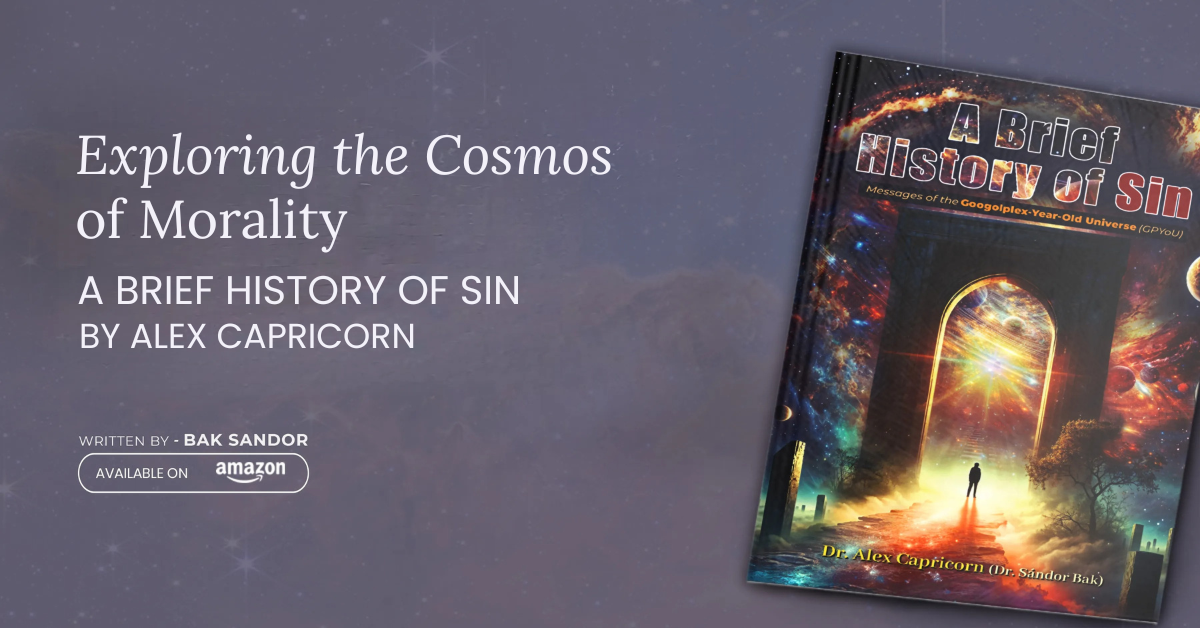
In a universe that stretches beyond comprehension, where time, space, and existence themselves blur under cosmic forces, most books shy away from asking the hardest questions. But Alex Capricorn’s A Brief History of Sin: Messages of the Googolplex-Year-Old Universe does the exact opposite — it dives headfirst into the abyss of existence, morality, and cosmic mystery, and invites readers to confront the possibility that our choices may shape reality itself.
A Cosmic Journey — Not Just Another Philosophy Book
This work doesn’t settle for easy answers or familiar narratives. Instead, Capricorn weaves together quantum physics, cosmic history, metaphysical inquiry, and moral philosophy — creating a tapestry that stretches from the birth of the multiverse to the personal weight of human decisions.
At its heart lies the provocative question: What if our universe is just one among many? If that’s the case, could our “sins, choices, even thoughts” ripple across reality — shaping not only our lives, but the fabric of existence itself?
Capricorn proposes — through bold theorizing — that perhaps a cosmic framework exists, one that binds morality and existence across time, space, and infinite possibility: his so-called “Metaplex Theory.”
It’s a heady idea. But the book doesn’t ask readers to accept it blindly; instead, it demands reflection, invites skepticism, and encourages deep introspection.
Themes That Cut Deep: Existence, Sin, Consciousness, and the Multiverse
Through this book, several core themes emerge — each unsettling, expansive, and profoundly human:
- Existence vs. Observer: What if reality depends on observation? If the universe is observed into existence, do our choices carry causal weight beyond conventional morality? The book pushes this boundary.
- Consciousness & Infinity: If consciousness and universe intersect, what does that mean for identity, purpose, and cosmic responsibility? Capricorn doesn’t shy away from such metaphysical territory.
- Moral Gravity: The moral dimension of the book isn’t derivative — it’s foundational. The idea that “sin” might have consequences beyond human lifespan, or that choices may echo across cosmic scales, gives ethical reflection a vast, almost sacred scope.
- Multiverse as Moral Landscape: Instead of treating other universes as sterile science-fiction playgrounds, Capricorn suggests they might reflect moral, spiritual, or existential layers — making our personal decisions part of a larger cosmic narrative.
An Intellectual Odyssey for Brave Minds
A Brief History of Sin isn’t for everyone. It doesn’t hold your hand. Instead, it requires readiness — to question, to doubt, to wrestle with ideas that might unsettle your worldview. But for those willing to embark on the journey, the reward is rare: a renewed sense of awe, a deeper appreciation for existence, and the humbling realization that what we call “sin,” “choice,” and “consequence” may be far more significant than previously imagined.
Capricorn doesn’t offer easy solace. He provides a mirror — dark, infinite, reflective — asking readers to look beyond their daily lives and consider their place in a cosmos that may be more alive than we think.
Who Will Find This Book Most Transformative
This book speaks especially to readers who:
- I am fascinated by the intersection of science and spirituality
- Enjoy philosophical speculation, cosmic theories, and existential questions
- Are you searching for a deeper meaning beyond everyday reality
- Appreciate thought experiments and intellectual challenge
- Want a unique blend of metaphysics, morality, and cosmic wonder
Whether you’re a philosopher, a science-curious reader, a seeker of spiritual meaning, or simply someone intrigued by what lies beyond the stars, this book invites you in.
Conclusion: Not Just a Read — a Cosmic Invitation
The Brief History of Sin is not a comfortable read — and that’s what makes it extraordinary. It challenges, provokes, and expands the mind. It doesn’t promise certainty. Instead, it offers possibility: the possibility that every choice, every thought, might matter on cosmic scales we’re only beginning to imagine.
If you’ve ever felt small beneath the stars — or wondered whether humanity means more than the sum of its parts — Alex Capricorn’s latest work may just change how you see the universe — and yourself.
Leave feedback about this