
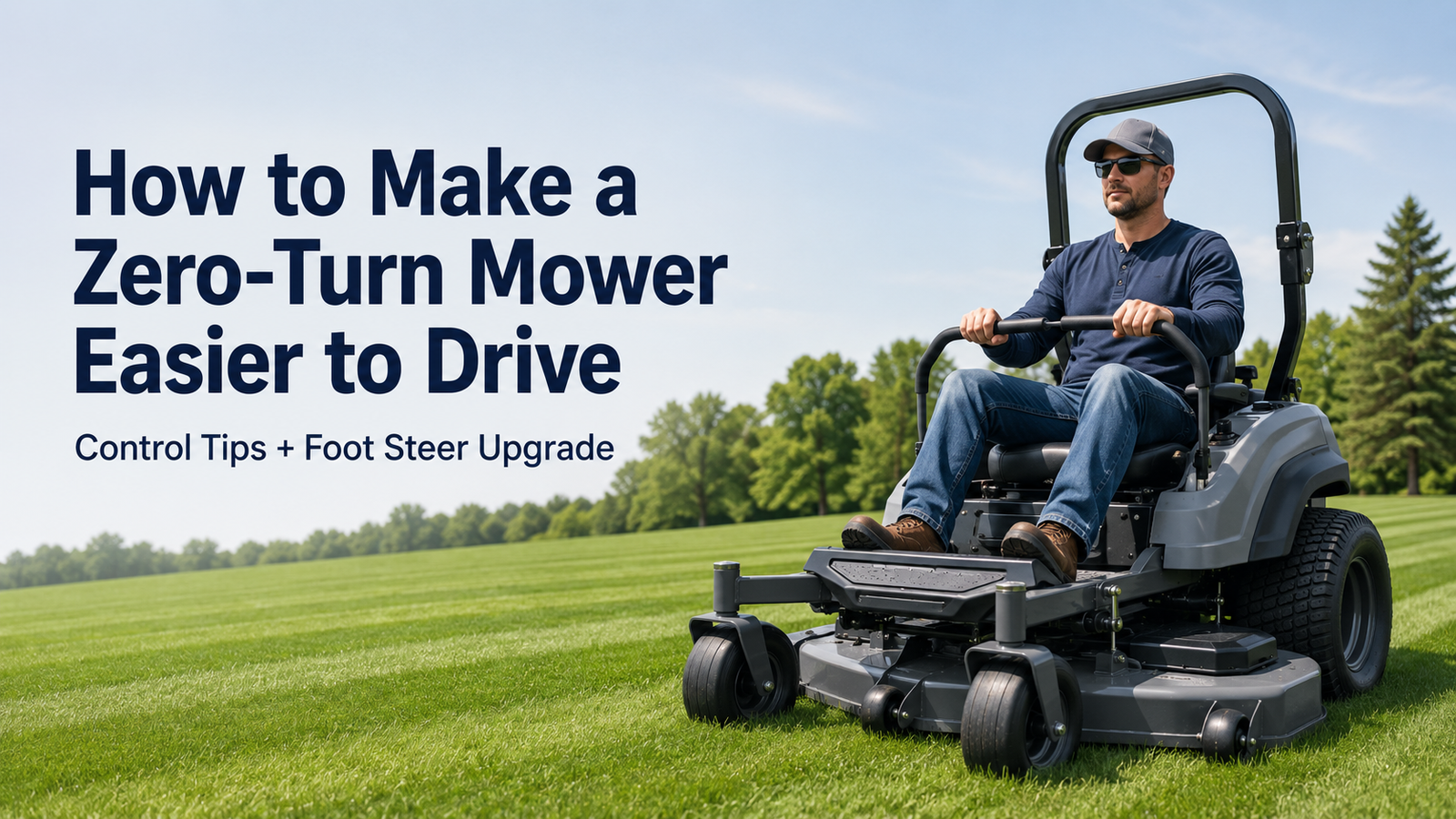
Zero-turn mowers are built for speed, precision, and productivity. They can cut large properties faster than many traditional riding mowers and maneuver around trees, fences, landscaping, and tight corners with impressive control. But for many operators, especially beginners, a zero-turn mower can feel sensitive, jerky, or difficult to drive at first.
Quick Answer: The easiest way to make a zero-turn mower easier to drive is to slow down, use smooth steering inputs, check tire pressure, adjust tracking, practice on open ground, and improve operator comfort. If your mower works properly but still feels tiring to control, a foot steering upgrade like Womack Foot Steer may help give you a more comfortable way to manage steering.
This guide explains why zero-turn mowers can be hard to drive, how to improve control, and when a zero-turn mower steering upgrade may be worth considering.
Why Zero-Turn Mowers Can Be Hard to Drive
A zero-turn mower does not drive like a regular riding lawn mower. Instead of a steering wheel on most models, the operator uses two lap bars. Each lap bar controls one rear drive wheel. Pushing both bars forward moves the mower forward. Pulling them back slows or reverses the mower. Moving one bar more than the other causes the mower to turn.
That independent wheel control is what makes a zero-turn mower so maneuverable, but it also creates a learning curve. Small movements can cause big changes in direction, especially at higher speeds. Toro notes that zero-turn mowers use control levers instead of steering wheels, and operators should keep speed under control while using smooth, even pressure on the controls.
For new users, the mower may feel too responsive. For experienced users, long mowing sessions can still become tiring because both hands and arms are constantly working the controls.
Start by Slowing Down
The first and simplest way to make a zero-turn mower easier to drive is to reduce your speed.
Many operators struggle because they try to mow too fast before they are comfortable with the controls. Zero-turn mowers are powerful machines, and speed makes every steering input more sensitive. If you push the lap bars too far forward, even a small correction can make the mower jerk or drift.
Practice at a lower speed first. Use an open area with no obstacles. Drive straight lines, gentle curves, and wide turns before attempting tight turns around trees or landscaping.
Cub Cadet recommends becoming familiar with the operator’s manual and practicing control before mowing, especially because zero-turn mowers are faster and more responsive than standard riding mowers.
Use Smooth Steering Inputs
Jerky steering is one of the biggest reasons a zero-turn mower feels hard to drive. Sudden movements can cause rough turns, uneven cuts, turf damage, and operator fatigue.
Instead of pushing or pulling the lap bars quickly, use steady pressure. Think of the controls as precision inputs, not on/off switches. Move both bars evenly when driving straight. When turning, ease one bar back slightly rather than yanking it.
Smooth steering helps in three ways:
It makes the mower easier to control.
It creates a cleaner cut pattern.
It reduces strain on your hands, wrists, arms, and shoulders.
This is especially important around obstacles. When mowing near trees, fences, flower beds, or buildings, slow down before the turn and use gradual control movements.
Check Tire Pressure Before Adjusting Anything
If your zero-turn mower pulls to one side or feels hard to keep straight, check tire pressure before adjusting the steering system.
Uneven tire pressure can make one side of the mower sit lower or travel differently than the other. That can cause drifting, uneven tracking, and poor control. Even a small pressure difference between rear tires can affect how the mower handles.
Before every mowing session, or at least weekly during mowing season, check both rear tires with a quality gauge. Inflate them to the manufacturer’s recommended PSI listed in your owner’s manual.
This simple step can make a zero-turn mower easier to drive without replacing parts or making mechanical adjustments.
Make Sure the Mower Tracks Straight
Tracking refers to how well the mower drives in a straight line when both lap bars are pushed forward evenly. If the mower constantly drifts left or right, the tracking may need adjustment.
A zero-turn mower that does not track straight forces the operator to constantly correct direction. Over time, that makes mowing harder and more tiring.
Common signs of tracking problems include:
The mower pulls to one side.
One lap bar feels more responsive than the other.
Straight mowing lines are difficult to maintain.
The mower curves even when both controls are even.
You constantly fight the mower to keep it straight.
Most zero-turn mowers have tracking adjustment bolts or control linkage adjustments, but the process depends on the model. Always check your owner’s manual before making changes. If you are unsure, contact a dealer or mower service professional.
Adjust Your Seat and Body Position
Operator comfort plays a big role in mower control. If your seat is too far back, too far forward, or poorly adjusted, your arms may be stretched or cramped while using the lap bars.
A good driving position should allow you to:
Sit upright with your back supported.
Keep your shoulders relaxed.
Reach the lap bars without stretching.
Bend your elbows slightly.
Keep your feet stable on the foot platform.
See clearly around the mower deck.
Poor posture makes the mower feel harder to control and increases fatigue during long mowing sessions. If your mower has an adjustable seat, armrests, or control levers, set them before mowing.
Commercial mowing operators should pay special attention to this. Small comfort problems become much bigger when you are mowing for several hours a day.
Practice Wide Turns Before Tight Turns
One of the biggest advantages of a zero-turn mower is its ability to turn tightly. But that does not mean every turn should be a zero-radius pivot.
Sharp pivot turns can tear turf, especially on soft, dry, or wet grass. They can also make the mower feel unstable for beginners. Instead, practice wider turns first.
Use a three-point or K-turn when needed. This means turning gradually, backing slightly if needed, and lining up for the next pass without twisting the mower sharply in one spot.
Wide turns are easier to control and better for lawn appearance. Once you are comfortable, you can use tighter turns where appropriate.
Avoid Difficult Terrain Until You Are Comfortable
Slopes, wet grass, drop-offs, ditches, and uneven ground make zero-turn mowers harder to control. They also increase safety risk.
Toro warns operators to avoid steep slopes and sudden drop-offs, and to avoid sudden speed or direction changes on hills. Their guidance also says to stay off slopes greater than 15 degrees.
If you are learning how to drive a zero-turn mower, start on flat, open ground. Avoid hills and wet grass until you are confident with the controls.
Also, do not try to stabilize the mower by putting your foot on the ground. Cub Cadet specifically warns against this because it can create serious safety risks.
Keep the Controls and Linkages Maintained
A mower is much harder to drive when its control components are loose, worn, or out of adjustment.
Inspect the steering controls regularly. Look for loose bolts, worn bushings, bent linkage, or uneven lap bar movement. If one control feels sloppy or delayed, the mower may not respond evenly.
Maintenance items to check include:
Lap bar bolts
Control arm linkage
Pivot points
Hydraulic drive response
Tire pressure
Parking brake function
Deck level and tire condition
A well-maintained mower is easier to drive, safer to operate, and more consistent during long mowing sessions.
Reduce Operator Fatigue
Even when a zero-turn mower is working correctly, it can still be tiring to operate. Lap bar steering requires constant hand and arm input. Over time, that can create fatigue in the wrists, forearms, shoulders, and upper back.
Fatigue makes the mower harder to drive because your reactions become slower and less precise. You may start overcorrecting, drifting, or making rough turns.
To reduce fatigue:
Take short breaks during long mowing jobs.
Keep your grip relaxed.
Avoid leaning forward.
Use smooth control movements.
Keep your shoulders relaxed.
Maintain your mower so it does not fight you.
If fatigue is a regular problem, it may be time to consider a comfort-focused control upgrade.
Consider a Foot Steering Upgrade
If your mower is properly maintained but still feels tiring or awkward to control, a foot steering upgrade may help.
Foot steering gives operators another way to manage mower direction. Instead of relying only on hand-operated lap bars, the operator can use foot control to help steer the mower. This can reduce upper-body workload and give the operator more control options during long mowing sessions.
This is where Womack Foot Steer fits naturally.
Womack Foot Steer is designed for compatible zero-turn mowers and gives operators a more practical way to control their machine using foot steering. It does not replace good maintenance or safe operation, but it can make the mowing experience more comfortable for operators who want better control and less strain.
How Womack Foot Steer Can Help
Womack Foot Steer can help make a zero-turn mower easier to drive by giving the operator another control method. For homeowners with large properties or commercial lawn care operators who spend hours mowing, this can be a major comfort advantage.
Potential benefits include:
Less constant hand and arm workload
More comfortable control during long mowing sessions
Better control options around obstacles
Reduced upper-body fatigue
A more natural way to manage steering for some operators
Helpful support for commercial mowing productivity
The key point is this: if your mower has a mechanical problem, fix that first. But if your mower is working correctly and you still want a more comfortable control experience, Womack Foot Steer may be a smart steering upgrade to consider.
Steering Technique vs. Steering Upgrade
Before buying any upgrade, it helps to understand the difference between a technique problem, a maintenance problem, and a comfort problem.
If you are new to zero-turn mowers, you may simply need more practice. Start slow, use smooth inputs, and practice in an open area.
If the mower pulls to one side or does not track straight, you may need tire pressure correction, tracking adjustment, or service.
If the mower drives properly but your hands, arms, or shoulders get tired, you may need a comfort-focused upgrade like Womack Foot Steer.
This approach keeps the decision practical. Foot steering is not a replacement for maintenance, but it can be a valuable upgrade once the mower is mechanically sound.
Final Thoughts
Learning how to make a zero-turn mower easier to drive starts with the basics: slow down, practice smooth steering, check tire pressure, adjust tracking when needed, and keep the mower maintained.
Once the machine is working properly, focus on operator comfort. A mower that is easier to control is not only more comfortable, it can also help improve cut quality and reduce fatigue.
For operators who want better comfort and control, Womack Foot Steer offers a practical foot steering upgrade for compatible zero-turn mower models.
Looking for a better way to control your mower? Explore Womack Foot Steer to learn how foot steering can help make your zero-turn mower easier to drive.
Frequently Asked Questions
How do you make a zero-turn mower easier to drive?
Start by slowing down, practicing smooth lap bar movements, checking tire pressure, and making sure the mower tracks straight. If the mower is working properly but still feels tiring to control, a foot steering upgrade may help improve comfort.
Why is my zero-turn mower hard to steer?
A zero-turn mower may feel hard to steer because of high speed, jerky control input, uneven tire pressure, poor tracking adjustment, worn linkage, or operator fatigue. Start with maintenance checks before assuming the mower needs major repair.
Are zero-turn mowers hard for beginners?
Zero-turn mowers can be challenging at first because they use independent rear-wheel control instead of traditional steering. Most beginners improve quickly by practicing slowly in an open area with the blades disengaged.
Can foot steering make a zero-turn mower easier to control?
Yes, for some operators. A foot steering system like Womack Foot Steer can reduce reliance on hand-operated lap bars and provide another control option, especially during long mowing sessions.
Should I adjust tracking before upgrading steering?
Yes. If your mower pulls to one side or does not drive straight, fix tire pressure, tracking, or linkage issues first. Once the mower is mechanically sound, a steering upgrade can improve comfort and control.






Leave feedback about this