
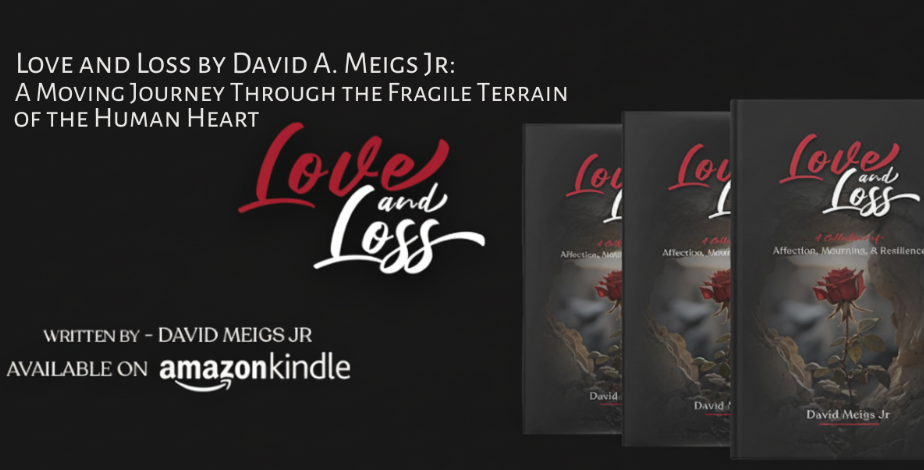
Introduction: Poetry as a Sanctuary for Emotion
In a world where emotions are often masked behind routine, responsibility, and unspoken expectations, poetry remains a refuge, a space where truth can exist without fear. Love and Loss by David A. Meigs Jr. enters this sanctuary with softness and sincerity, offering readers a deeply introspective collection of poems exploring the highs and lows that shape every human life. Through themes of affection, heartbreak, memory, and inner healing, Meigs presents poetry not just as art but as an emotional companion.
When Love Becomes a Story Worth Telling
The collection opens with poems that feel like quiet moments captured in language, the warmth of connection, the vulnerability of intimacy, and the joy of finding someone who understands us deeply. Meigs does not present love as a grand declaration, but as something intimate and fragile: a shared glance, a whispered promise, a gesture that lingers long after it’s over.
His reflections on love carry a sense of authenticity. The poems speak of affection that is tender but real, acknowledging both the beauty and the uncertainty that accompany emotional closeness. Meigs illustrates the simple truth that love is made not only from passion, but from the small moments that stitch themselves into our hearts without us realizing.
At its core, the book celebrates love as something transformative, a force that gives meaning to ordinary days and opens doors to parts of ourselves we rarely explore.
Loss That Echoes Through Time
The other side of Meigs’s collection is marked by loss not in a dramatic or overwrought manner, but in the quiet, aching way it exists in real life. These poems examine separation, heartbreak, and the emotional aftermath that follows when someone important drifts out of our world.
Loss is portrayed not as a single event, but as an emotional ripple effect that moves through memory and identity. Meigs explores the way grief settles into daily life:
- in the silence of an empty room,
- in the routines that now feel incomplete,
- in the unexpected moments when memories resurface,
- and in the slow realization that familiar feelings may never fully return.
What makes this portrayal so compelling is its honesty. The poems acknowledge that healing is not linear, that pain does not obey timelines, and that some memories hold a power we cannot easily escape. Rather than offering neat solutions, Meigs permits readers to feel to sit with their emotions without judgment.
Balancing the Heart’s Two Extremes
One of the profound strengths of Love and Loss is the way Meigs balances emotional opposites. Love and sorrow are not isolated themes; they weave together, creating a layered tapestry of human experience. This duality feels true to life; we rarely experience joy without the fear of losing it, nor do we experience loss without remembering the love that came before.
The poems reflect this intertwined nature of human emotion. Some lines carry the warmth of affection, immediately followed by the shadow of absence. Other pieces show how love can persist even after the person is gone, living on in memories, lessons, and quiet moments of longing.
Through this balance, Meigs emphasizes that emotional complexity is not something to avoid; it is what makes life meaningful.
A Writing Style That Speaks Directly to the Soul
Meigs’s writing style is rooted in clarity and emotional intent. He avoids overwrought metaphors and elaborate language, instead choosing simplicity that allows each word to resonate. His poems often feel like gentle confessions, reflections spoken aloud in a quiet room, or thoughts whispered to no one in particular.
This simplicity makes the collection deeply accessible. Readers do not need to search for hidden meaning or dissect every line. The emotion is there, raw and visible, waiting to be felt.
Imagery plays a vital role in the experience: a fading light, a drifting memory, a quiet morning alone. These visual anchors guide readers through the emotional shifts within the poems, creating a visceral connection to the themes explored.
Universal Questions Hidden Within Each Poem
Like all powerful poetry, Love and Loss raises emotional questions that continue long after the book is closed:
- Why does love linger even when it ends?
- How do memories guide or haunt us?
- What does healing look like when the heart still holds on?
- Is loss an ending, or a transformation?
Meigs does not dictate answers. Instead, he opens the emotional doorway, allowing readers to step into their own experiences. This universal quality makes the book suitable for anyone who has ever loved deeply, lost profoundly, or reflected on what those experiences meant.
Conclusion: A Tender, Honest Exploration of What It Means to Feel
Love and Loss by David A. Meigs Jr. is more than a poetry collection; it is a meditation on the emotional truths that shape who we are. Through heartfelt reflections, gentle language, and an unwavering commitment to emotional authenticity, Meigs delivers a body of work that comforts, challenges, and heals.
For readers seeking poetry that feels personal, genuine, and emotionally resonant, Love and Loss stand out as a beautifully crafted reminder that love and grief are not opposites, but intertwined realities that make us human.





Leave feedback about this